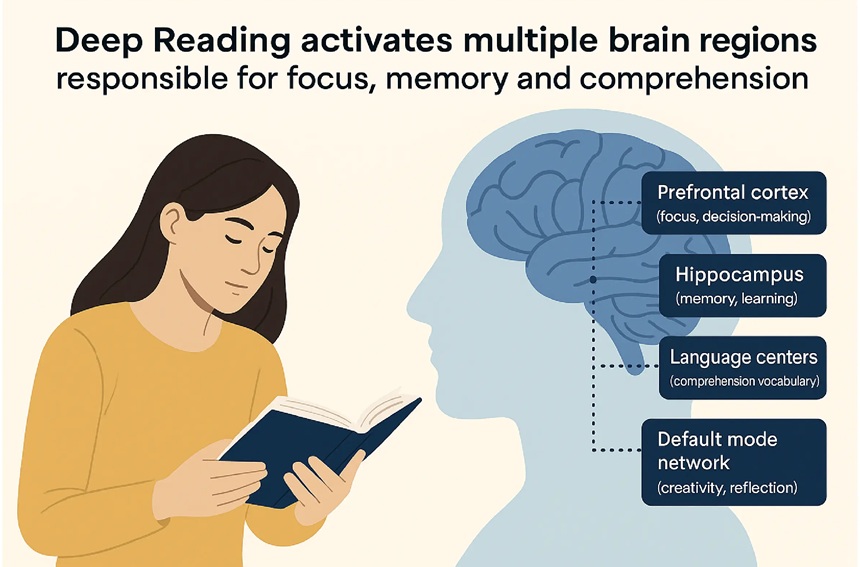
Deep reading activates multiple brain regions responsible for focus, memory, and comprehension.
In today’s digital world, students consume information faster than at any point in history. Social media, short-form videos, notifications, and constant screen-swiping have shortened attention spans and made deep, focused reading increasingly rare. Yet research shows that deep reading—slow, focused, distraction-free reading—is one of the most powerful ways to strengthen the brain.
Deep reading is not simply reading more carefully. It is a cognitive process that engages attention, memory, critical thinking, emotional intelligence, and reasoning. Neuroscientists have found that during deep reading, neural circuits across the brain light up in complex patterns not activated during quick scanning or skimming.
1. What Is Deep Reading?
Deep reading occurs when the reader fully concentrates on text without interruptions, giving the brain time to analyze, reflect, connect ideas, and build long-term memory. Unlike skimming, deep reading activates:
- The prefrontal cortex (focus and decision-making)
- The hippocampus (memory and learning)
- Language centers (comprehension and vocabulary)
- Default mode network (creativity and reflection)
This level of engagement is essential for understanding complex ideas and building academic skills.
2. Why Deep Reading Is Declining
Researchers have found that digital habits are changing the structure of reading itself. Common causes include:
- Constant switching between apps and tabs
- Short-form content replacing long-form reading
- Notifications breaking concentration
- Reading on small screens that encourage scrolling instead of reflecting
- Fragmented study materials scattered across devices
These habits train the brain for speed, not depth.
3. Brain Science of Deep Reading
Neuroscientists at MIT, Stanford, and UCLA have discovered that deep reading strengthens:
- Memory — complex neural connections form when reading slowly
- Critical thinking — readers analyze and evaluate ideas more deeply
- Focus — long periods of attention enhance cognitive endurance
- Empathy — reading narratives activates emotional centers of the brain
In contrast, fast digital consumption activates shallow neural pathways, making it harder to retain information.
4. Benefits of Deep Reading for Students
Improved Comprehension
Deep reading allows students to grasp complex theories, arguments, and technical explanations far better than scanning.
Better Long-Term Memory
When students slow down, the hippocampus stores information more efficiently, increasing long-term retention.
Higher Academic Performance
Studies show that students who regularly practice deep reading perform better on exams, essays, and problem-solving tasks.
Stronger Critical Thinking
Deep reading encourages reflection and analysis, which helps students make connections across subjects.
5. How Students Can Practice Deep Reading
5.1 Remove Digital Distractions
Turn off notifications, close unused tabs, and activate airplane mode during reading sessions.
5.2 Read From Organized PDFs
Instead of jumping between multiple files, students should combine their readings into a single PDF. Tools like PDFmigo.com make it easy to organize chapters, articles, and notes in one place for distraction-free reading.
5.3 Limit Skimming
Skimming trains the brain for speed but weakens comprehension. Students should slow down during important parts.
5.4 Use Active Reading Techniques
- Highlight only key ideas
- Write margin notes
- Summarize each section
- Ask questions about the text
5.5 Practice Regularly
Just like exercise, deep reading improves with consistent practice.
6. Digital Deep Reading Tips
Many students prefer reading on screens. To support deep reading:
- Use a larger screen if possible
- Increase line spacing for better focus
- Use PDF annotations to highlight important points
- Read in full-screen mode to avoid distractions
Conclusion
Deep reading is essential for academic success and cognitive development. In a world dominated by fast digital content, slowing down and reading deeply helps students strengthen memory, focus, comprehension, and critical thinking. By organizing study materials effectively using tools like PDFmigo.com, learners can create the ideal environment for distraction-free deep reading.