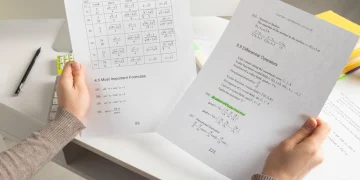
Secondary maths introduces increasingly complex concepts and often requires students to apply knowledge learned in earlier years. Difficulties with foundational skills can therefore affect a student’s ability to understand later topics.
Falling behind does not simply mean receiving a lower test mark. It may involve persistent difficulty following lessons, completing homework independently, or applying familiar concepts to unfamiliar questions.
A structured approach can help students determine where difficulties occur and what support may be appropriate. The first step is identifying the nature and extent of the learning gap.
How Can Students Identify When They Are Falling Behind in Secondary Maths?
Students can review their classwork, homework, quizzes, and examinations to identify recurring problems. Repeated mistakes in the same topic can indicate that a concept or underlying skill requires further attention.
Common signs of difficulty may include:
- Frequently being unable to complete questions without referring to worked examples
- Making repeated errors in the same type of calculation
- Struggling to understand new lessons that depend on earlier concepts
- Taking substantially longer to complete familiar question types
- Being unable to explain the steps used to reach an answer
Keeping an error log can make these patterns easier to identify. Students can record the question type, their mistake, the correct method, and the concept that needs review.
It is also important to distinguish between different sources of difficulty. A student may understand a concept but make calculation errors, while another may lack the conceptual knowledge required to begin the question.
Once the problem areas have been identified, students can select study methods that directly address them.
What Study Methods Can Help Students Improve Their Maths Understanding?
Maths revision should involve active problem-solving rather than relying only on reading notes or solutions. Students need opportunities to retrieve knowledge and apply mathematical procedures independently.
Useful study methods include:
- Reviewing worked examples: Examine how each step leads to the solution before attempting a similar problem independently.
- Practising without notes: Attempt questions without immediately referring to formulas or model solutions.
- Checking incorrect answers: Determine whether errors resulted from misunderstanding, calculation, interpretation, or missed steps.
- Using spaced review: Revisit previously studied material over time rather than concentrating all revision into one session.
- Mixing question types: Practise different types of problems so that selecting the correct method becomes part of the task.
Students should also compare their answers with reliable solutions and correct misconceptions promptly. Repeating large numbers of questions without understanding previous mistakes may reinforce ineffective approaches.
Effective study methods become more useful when students apply them to the right material. The next step is deciding which topics deserve priority.
Which Maths Topics Should Students Prioritise First?
Students should generally begin with foundational topics that support later areas of the syllabus. The exact priorities will depend on the curriculum, year level, and individual learning gaps.
A simple prioritisation framework can help:
| Priority | Type of Topic | Suggested Action |
| High | Foundational topic that affects several current topics | Review first |
| High | Current topic with major knowledge gaps | Address promptly |
| Medium | Topic understood but affected by frequent errors | Practise targeted questions |
| Lower | Topic already completed accurately and independently | Maintain through periodic review |
For example, weaknesses in arithmetic manipulation or algebra may create difficulties when those skills are required within more advanced problems. Students should therefore identify prerequisite knowledge rather than focusing solely on the latest chapter.
This approach allows revision time to target gaps with the greatest effect on current learning. However, independent study may not always be sufficient, particularly when students cannot identify why their solutions are incorrect.
When Should Students Ask for Additional Maths Support?
Students should consider asking for help when they repeatedly struggle with the same concepts despite reviewing lessons and practising independently. Seeking clarification early can prevent unresolved gaps from affecting subsequent topics.
Possible sources of support include classroom teachers, school consultation sessions, classmates, study groups, online educational resources, and structured maths tuition for secondary students. The appropriate option depends on the student’s specific learning needs and available resources.
That said, when considering maths tuition for weak students, parents and students can first identify the areas requiring support. This may include foundational knowledge, current syllabus content, problem-solving methods, or examination techniques.
Additional support should complement regular learning rather than replace independent practice. Students still need to attempt questions, review errors, and monitor whether their understanding is improving.
FAQs
Can students catch up after falling behind in secondary maths?
Students can address learning gaps by identifying weak areas, reviewing prerequisite concepts, practising relevant questions, and seeking clarification when necessary. The time required will depend on the extent of the gaps and the curriculum involved.
How often should students practise maths?
Regular practice allows students to revisit concepts and identify difficulties before they accumulate. The appropriate frequency depends on the student’s timetable, learning needs, and school workload.
Should students revise old or current maths topics first?
Foundational gaps that directly affect current lessons usually deserve early attention. Students can then balance this review with current schoolwork to avoid creating new gaps.
When should a student ask a maths teacher for help?
Students should ask for clarification when they cannot understand a concept, repeatedly make the same error, or cannot complete questions after reviewing relevant materials.
Is additional maths tuition always necessary?
No. Some students can resolve difficulties through teacher support, structured revision, school resources, and independent practice, while others may benefit from additional instruction.
Visit Sirius Mathematics to build a clearer path back to maths progress.